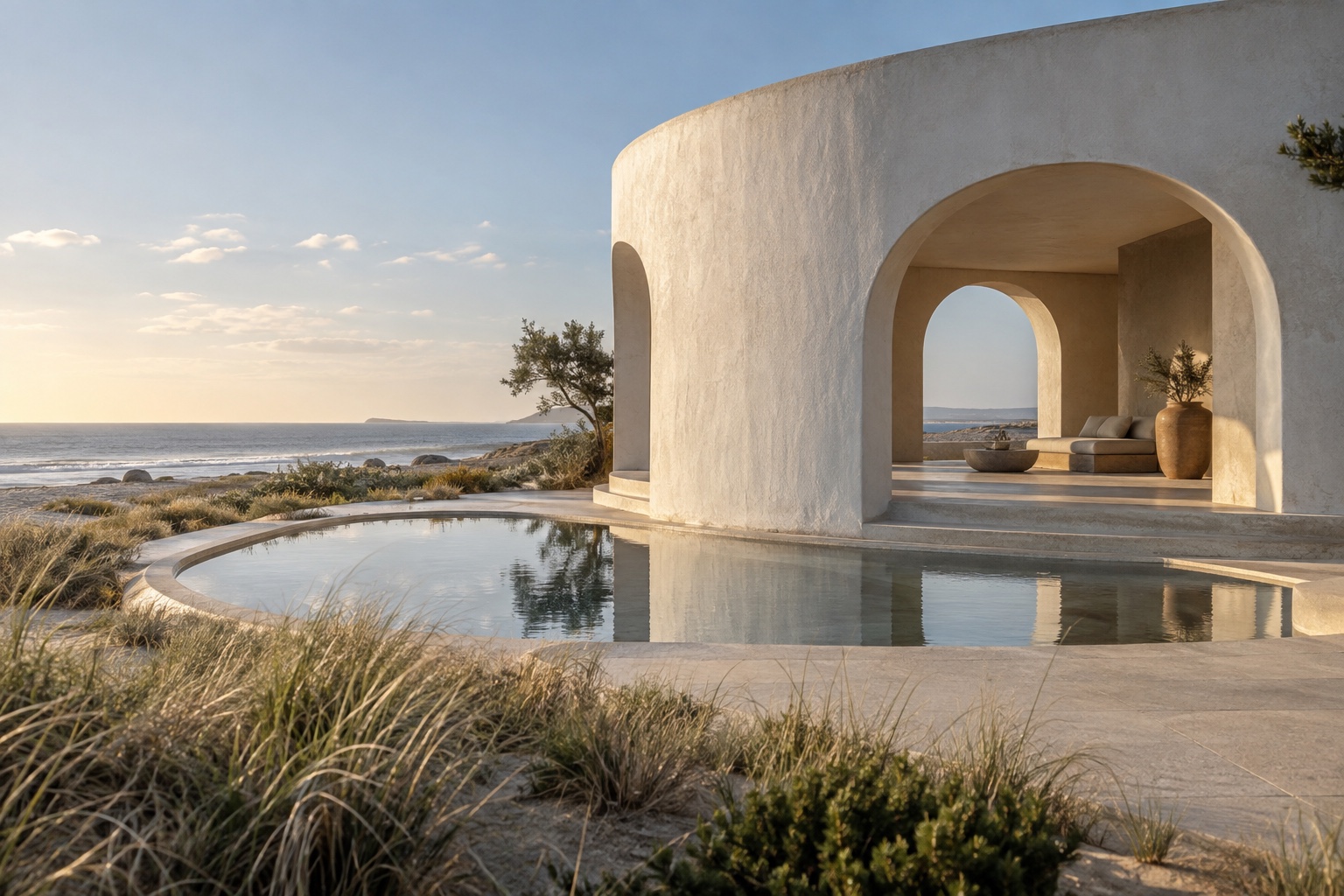

The pavilion is made from elementary forms—a circle, an arch, a low wall—yet its effect is unexpectedly tender. Curves slow the eye and gather shadow; the building appears to hold the landscape rather than divide it.
Set among dunes, it serves as a seasonal retreat: one living space, a sheltered court and a shallow pool that reflects the changing sky.
Form shaped by climate
The largest arch faces the sea but is deep enough to remain shaded at midday. Smaller openings frame cross-breezes, while the rounded outer wall deflects the strongest coastal wind.
Hand-troweled plaster keeps the geometry from feeling abstract. Its small ridges catch warm light and give the white surface a depth that changes by the hour.
Geometry becomes humane when it begins to account for bodies, weather and the pleasure of shade.
A modernism of touch
Inside, built-in seats follow the wall and eliminate the need for much furniture. Limestone underfoot remains cool; timber shutters add warmth and allow the room to close completely in winter.
The pavilion’s clarity never becomes austerity. It demonstrates that reduction can be generous when it preserves what matters most: a protected place to sit, a view of water and the sensation of light moving across a wall.
Conversation