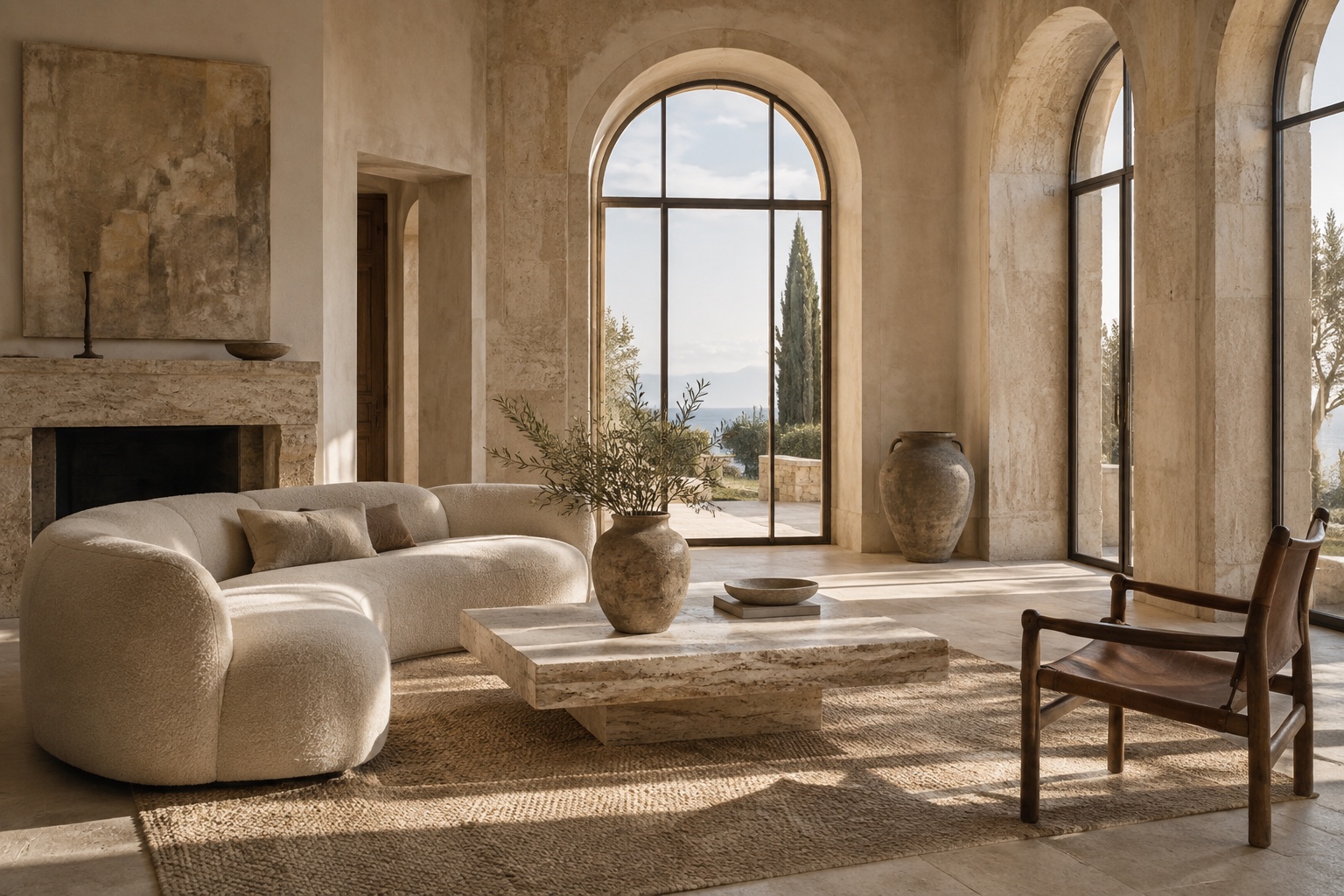

Stone can make a room feel permanent, but permanence need not mean severity. In this coastal interior, travertine is used less as a declaration than as a continuous ground: underfoot, around the fireplace and in the deep reveals of three arched windows.
The palette is narrow, yet the room never feels monochrome. Light moves across honed surfaces differently from the way it settles into boucle, oak and hand-thrown clay. What first appears beige is, on closer inspection, a field of chalk, sand, smoke and honey.
Let the material lead
The designers resisted the urge to sharpen every junction. Edges are softly eased, plaster meets stone with a hand-finished irregularity and the low table retains the visible strata of the block from which it was cut.
Furniture is deliberately sparse. A curved sofa brings softness without competing with the architecture; an old wood chair introduces a human scale; branches from the garden offer the only emphatic vertical line.
A quiet room is not an empty room. It is one in which every material has enough space to be understood.
Warmth without ornament
The success of the room lies in its refusal of easy contrast. There is no single dark note arranged to make the pale surfaces look paler, no bright art deployed as punctuation. Instead, warmth accumulates through texture and use.
By evening, pools of low light gather around the sofa and fireplace. The stone recedes, the wood comes forward and the room changes register entirely—from gallery-like calm to something closer to shelter.
Conversation