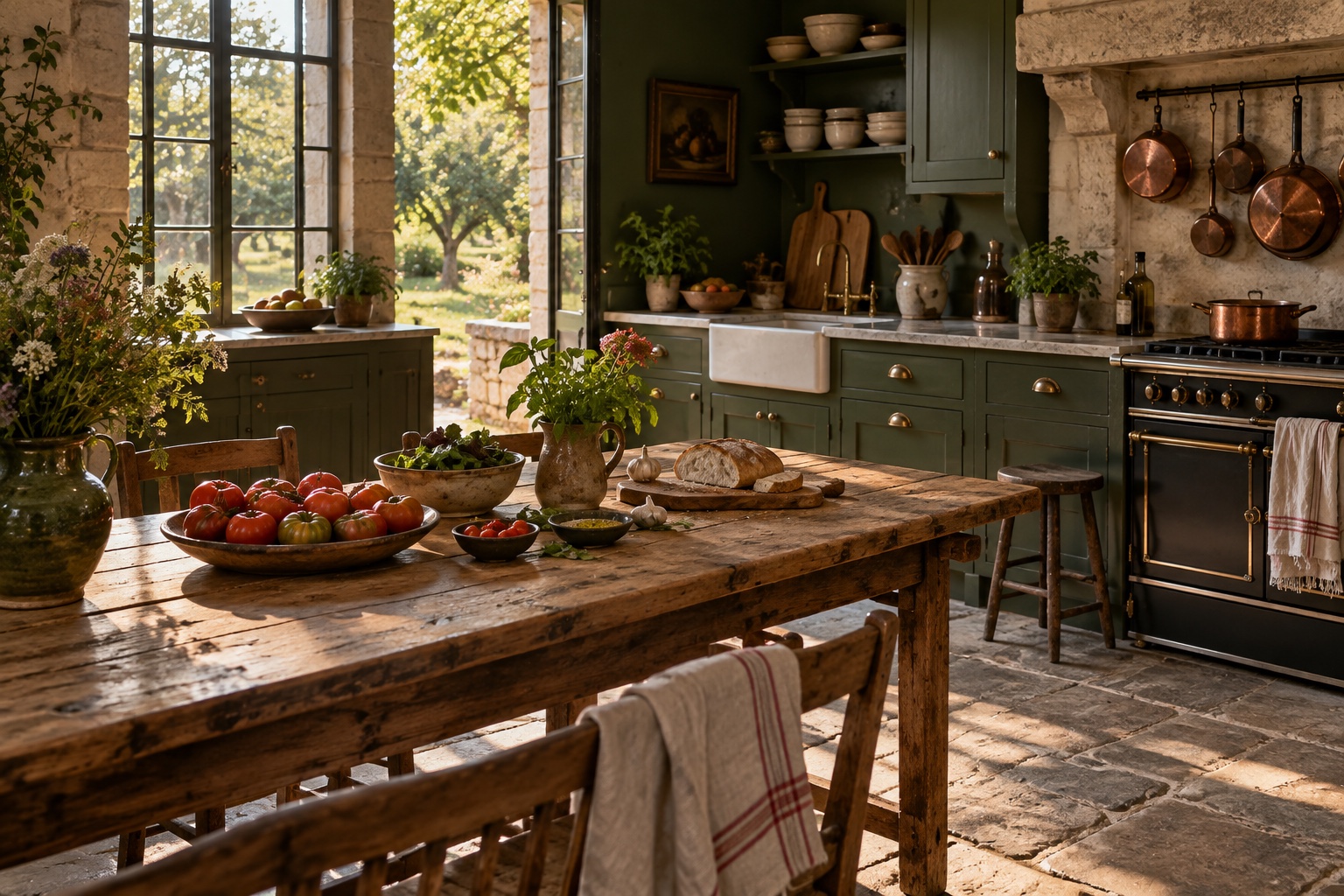

This kitchen was not designed around a perfect photograph. Its long table bears knife marks, the copper has darkened unevenly and the cabinet beside the stove refuses to close unless lifted slightly. These are not defects to be corrected. They are the room’s biography.
The owners collect functional things: mixing bowls, old boards, glazed jars and pans chosen for how they cook rather than how they coordinate.
A room assembled over time
Deep green cabinetry gives the collection a visual ground. Open shelves keep everyday pottery accessible, while less frequently used pieces occupy the high ledge above the window.
The oak table came from a nearby bakery and remains the center of the plan. Meals are prepared at one end, eaten at the other and extended indefinitely when friends arrive.
The best kitchens are edited by habit: what is useful stays close, and what is loved earns its place.
Beauty with a job to do
Sunlight moves across the stone floor in the afternoon, catching the copper and making even a bowl of tomatoes feel briefly ceremonial. Yet the effect is never fragile.
The room works because it welcomes disorder and recovers easily. A cloth is shaken, boards return to the wall and tomorrow’s bread begins under a bowl. Its beauty is inseparable from the work.
Conversation